
A qualified charitable distribution, or QCD, lets you give money directly from your IRA to a charity once you are 70½ or older. In 2026 you can give up to $111,000 this way, and a QCD can count toward your required minimum distribution for the year.
For people who already give regularly, it can be a simple way to give from the account the money is already in. Here is how it works and what to watch for before December 31.
How a qualified charitable distribution works
You ask your IRA custodian to send money straight from your IRA to a qualified charity. The check or transfer goes to the charity, not to you. The charity sends you a written acknowledgment, just as it would for any gift.
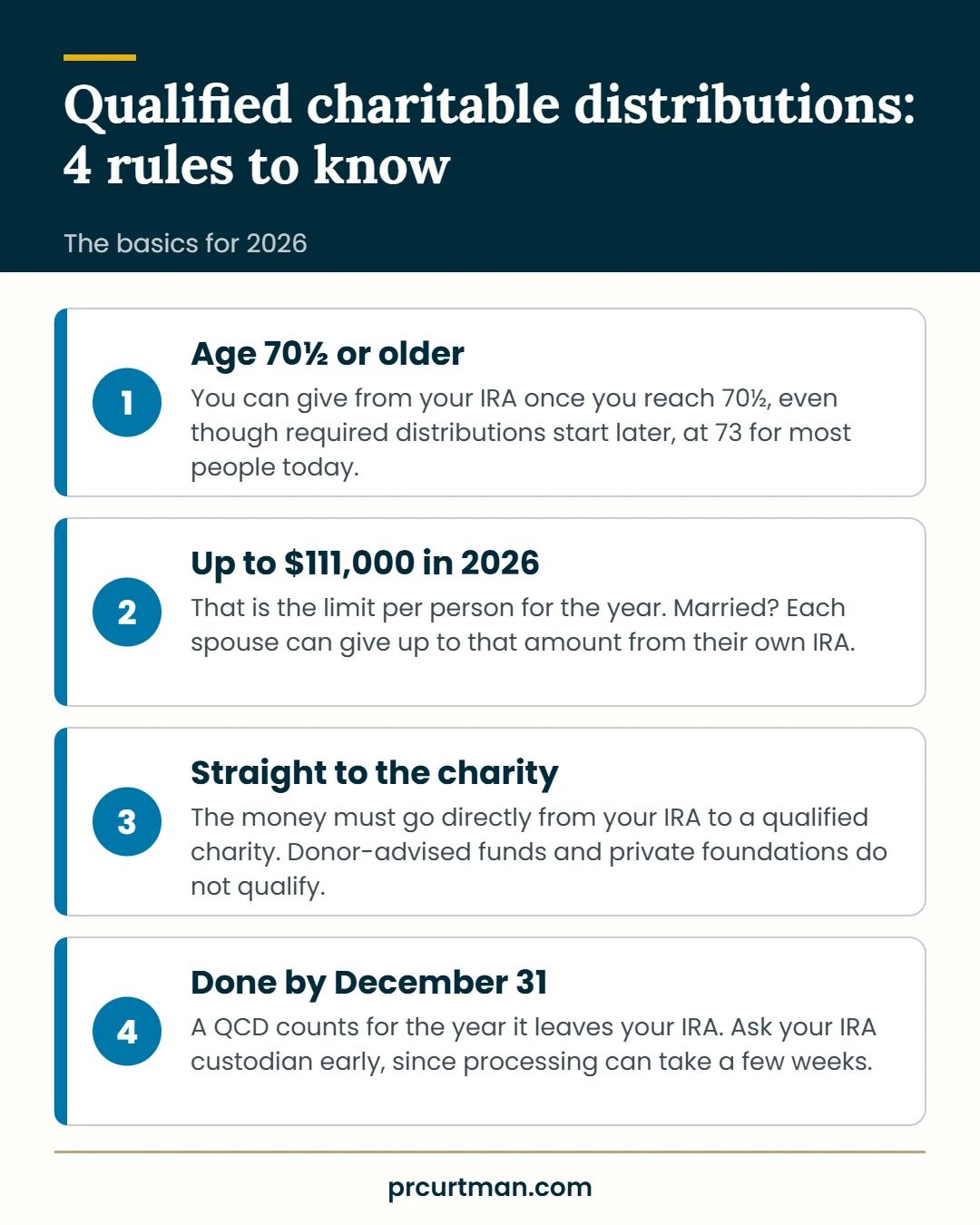
- Who: IRA owners age 70½ or older. Inherited IRA owners who meet the age rule can also give this way.
- How much: up to $111,000 per person in 2026. A married couple can each give up to that amount from their own IRAs.
- Which accounts: traditional, rollover and inherited IRAs. SEP and SIMPLE IRAs only if no new contributions are going in.
- When: the money must leave the IRA by December 31 to count for that year.
QCDs and your required minimum distribution
Required minimum distributions start at 73 for most people today. Once they apply, a QCD can count toward the amount you must take for the year. Some people give part of their RMD this way and take the rest as income.
How a QCD affects your own taxes depends on your full situation, including whether you itemize. Please talk with your tax professional before you decide how much to give this way.
Rules that trip people up
- It must go straight to the charity. If the money is paid to you first and you then donate it, it is not a QCD.
- Not every charity qualifies. Donor-advised funds and private foundations are not eligible to receive a QCD.
- 401(k) plans do not allow QCDs. The money has to be in an IRA first. Our 401(k) rollover page explains your options for an old plan.
- Timing matters. Custodians get busy in December. Start early so the gift is complete by December 31.
- Keep the paperwork. Save the charity’s acknowledgment and your IRA statement showing the distribution.
Giving that fits your values
For many people, giving is part of how they live out their faith. A QCD can be one tool for that, alongside your other year-end steps. See our year-end portfolio checklist, or read 7 questions Christian investors should ask about their portfolio.
P.R. Curtman Investments is a fee-only investment advisor for anyone with a portfolio. Fee-only, so we do better when you do better. You work directly with Paul, by appointment. We meet by phone, video, or in person somewhere convenient for you.
FAQ
What is the qualified charitable distribution limit for 2026?
$111,000 per person. The IRS adjusts the limit each year for inflation.
Can I make a QCD before my RMDs start?
Yes. QCDs are allowed from age 70½, even though required distributions begin later for most people.
Can I give to my donor-advised fund with a QCD?
No. Donor-advised funds and private foundations cannot receive QCDs. The gift must go to an eligible public charity, such as a church or a qualified nonprofit.
Can I make a QCD from my 401(k)?
No. QCDs only come from IRAs. You would need to move the money into an IRA first.
Your next step
- Ready to talk it through? Book a call with Paul.
- Have a quick question first? Ask it anytime in the chat on this page.
- Investing with your faith in mind? Get the free Christian Investor’s Checklist.
This article is for education only and isn’t individual investment, tax or legal advice. Please talk with your tax professional and a qualified advisor about your situation.