
A fee-only financial advisor is paid only by you, the client, through a flat fee, an hourly rate or a percentage of the assets they manage. A commission advisor is paid mainly by the companies whose products you buy, such as a mutual fund, an annuity or an insurance policy.
Both kinds of advisors can be good at what they do. Knowing how yours is paid simply helps you understand what you are paying and ask better questions.
How a fee-only financial advisor gets paid
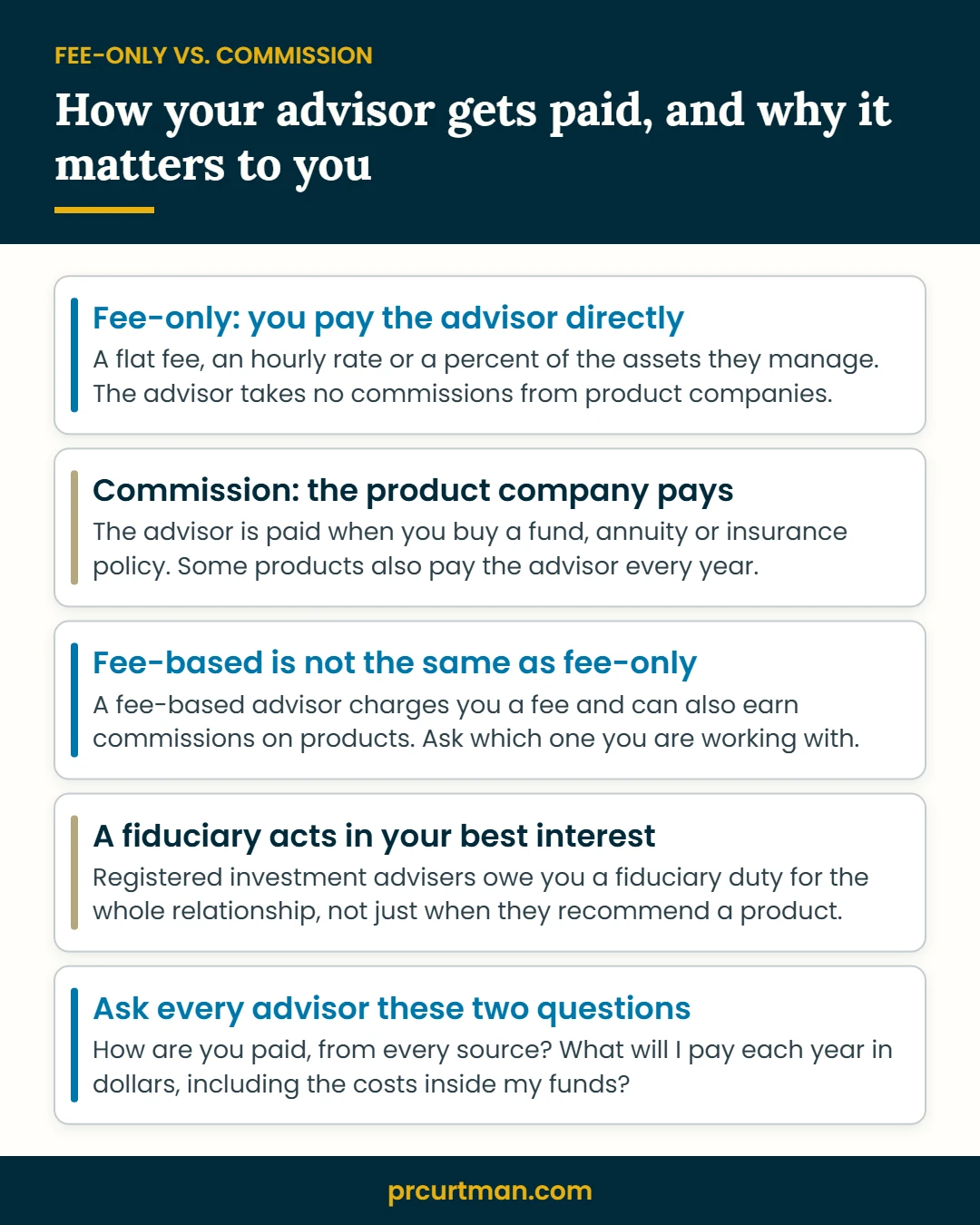
A fee-only financial advisor charges you directly, and that is their only pay. The most common ways are:
- A percentage of assets. For example, a yearly fee based on the value of the portfolio they manage for you.
- A flat or retainer fee. A set amount for ongoing advice or a planning project.
- An hourly rate. You pay for the time you use.
Because the fee shows up on your statement or invoice, you can see exactly what you pay. At P.R. Curtman Investments, we are fee-only, so we do better when you do better.
How commission pay works
A commission advisor is usually paid by the product company when you buy something. That pay can come in a few forms:
- An up-front commission when you buy a fund, annuity or insurance policy.
- Ongoing payments built into some funds and annuities, paid every year you own them.
- Surrender charges on some annuities and policies if you get out early.
These costs are often inside the product, so they may not show up as a separate line on your statement. That is why it helps to ask.
Fee-only, fee-based and commission: the labels
The names sound alike but mean different things:
- Fee-only: paid only by the client. No commissions.
- Fee-based: charges a fee and can also earn commissions on products.
- Commission-based: paid mainly through the products you buy.
If an advisor says “fee-based,” it is fair to ask whether they also earn commissions.
What “fiduciary” adds
Registered investment advisers owe their clients a fiduciary duty. That means acting in your best interest for the whole relationship, not only at the moment a product is recommended. Brokers who sell products follow a different rule, called Regulation Best Interest, which applies when they make a recommendation.
As a fee-only fiduciary, Paul acts in your best interest and is paid only if you choose to work with him. You can read more about how we work on our process page, or get our free guide, How Financial Advisors Get Paid.
Five questions to ask any advisor
- How are you paid, from every source?
- Are you a fiduciary at all times, and will you put that in writing?
- What will I pay each year, in dollars, including the costs inside my funds?
- Do you earn more if I buy one product instead of another?
- Where can I read your Form ADV? (You can look up any adviser at adviserinfo.sec.gov.)
Not sure what you are paying now? A second opinion review lays out your fees, risk and overlap in plain terms.
How we work with you
P.R. Curtman Investments is a fee-only investment advisor for anyone with a portfolio, whether you are building it, protecting it or living on it. You work directly with Paul, by appointment. We meet by phone, video, or in person somewhere convenient for you.
FAQ
Is a fee-only financial advisor more expensive?
Not necessarily. The fair way to compare is total yearly cost in dollars, including fund expenses and any product charges, for the same amount of money.
Is fee-based the same as fee-only?
No. A fee-based advisor can charge a fee and also earn commissions. A fee-only financial advisor is paid only by the client.
Can a commission advisor also be a fiduciary?
Some advisors work under both models. Ask whether they act as a fiduciary for every account and every recommendation, and ask for it in writing.
Is P.R. Curtman Investments fee-only?
Yes. We are a fee-only registered investment adviser and a fiduciary. Fee-only, so we do better when you do better.
Your next step
- Ready to talk it through? Book a call with Paul.
- Have a quick question first? Ask it anytime in the chat on this page.
- Want the bigger picture? Get the free Retirement Income Blueprint.
This article is for education only and isn’t individual investment, tax or legal advice. Please talk with a qualified professional about your situation.